
Kai Neumann · 4 October 2026
The Role of Specialized Note Platforms in Streamlining Educational Resource Curation for Remote Learners
Remote education has expanded rapidly since the early 2020s, and specialized note platforms now serve as central tools for organizing scattered digital materials into coherent collections that students can access from any location. These platforms integrate annotation tools, tagging systems, and cloud synchronization so learners avoid the common problem of losing track of PDFs, lecture recordings, and reading lists spread across multiple devices and services. Data from international education monitoring shows that structured digital curation reduces time spent searching for materials by measurable margins in university and secondary school cohorts.
Core Functions That Support Curation Workflows
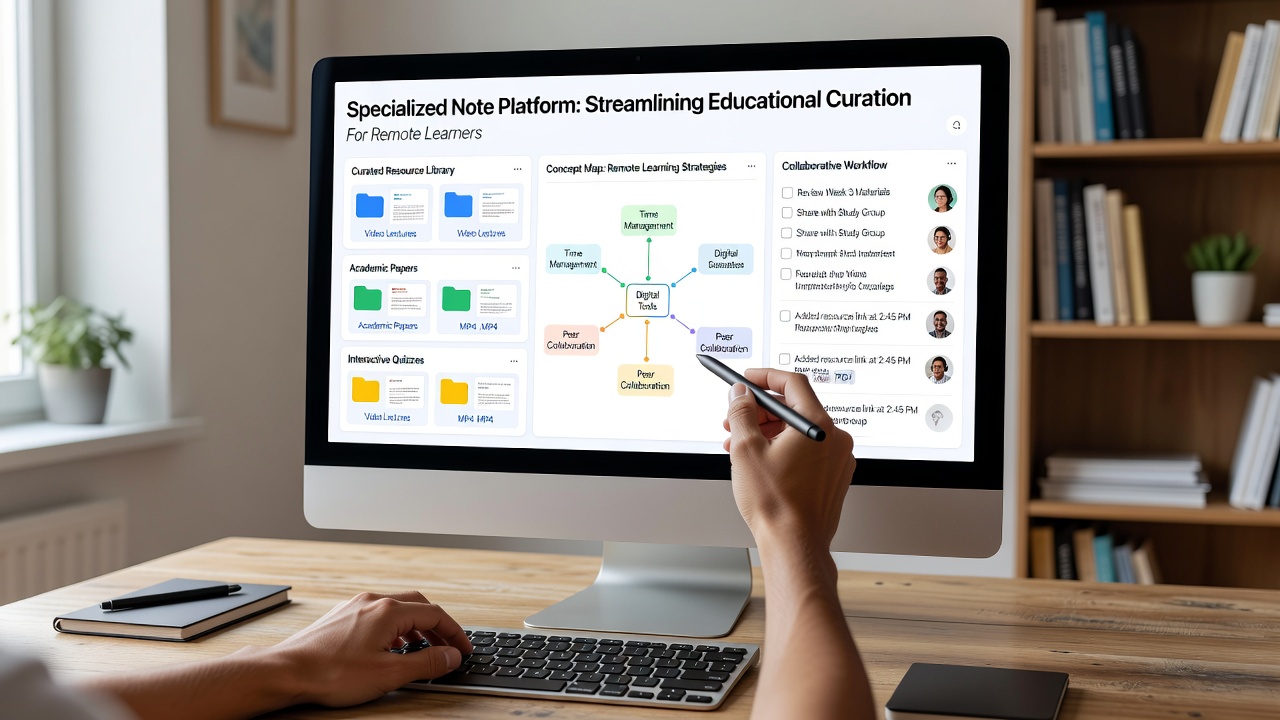
Specialized note platforms combine several technical capabilities that directly address the curation challenges faced by remote students. Users create hierarchical notebooks or workspaces where they import files, embed multimedia, and apply searchable metadata tags that remain consistent across semesters. Collaboration features allow small groups to comment on shared excerpts without altering original sources, while version histories preserve earlier states of notes. Integration with learning management systems such as Moodle or Canvas means new readings appear automatically inside the note environment, eliminating manual downloads that often lead to duplicate or outdated copies. Studies conducted by European higher education networks indicate that these combined functions produce measurable improvements in assignment completion rates when students maintain consistent tagging practices throughout a term.
Search and retrieval speed also improves because platforms index both user-generated text and embedded document content simultaneously. Learners therefore locate a specific diagram from a 40-page report within seconds rather than scrolling through folders. Export options preserve formatting for submission deadlines, and offline access modes ensure continuity during connectivity interruptions common in rural or mobile learning scenarios.
Evidence from Recent Remote Learning Environments
Research tracking cohorts in North American and Australian institutions between 2023 and 2025 documented how platform adoption correlated with organized resource libraries that students reused across multiple courses. One longitudinal project at a Canadian university followed 1,200 remote undergraduates and found that those who maintained annotated collections in a single platform referenced prior materials 34 percent more frequently than peers relying on browser bookmarks alone. Similar patterns emerged in vocational training programs in New Zealand, where apprentices compiled workplace evidence and theoretical readings inside shared workspaces that instructors could review remotely. These examples illustrate concrete usage rather than speculative benefits.
Adaptations Observed in October 2026
By October 2026 platform developers had introduced AI-assisted tagging that suggests categories based on syllabus keywords supplied by instructors, further reducing manual organization time. Government education departments in several OECD countries began publishing guidelines recommending such platforms for accredited distance programs, citing improved audit trails for assessment materials. Figures released by the Australian Department of Education show increased funding allocations for institutions that demonstrate systematic resource management through approved digital tools. These policy shifts reflect accumulated usage data rather than theoretical projections.
Limitations and Ongoing Adjustments
Not every learner adopts these platforms uniformly, and access barriers persist where devices or reliable internet remain limited. Privacy regulations in teh European Union require explicit consent mechanisms for shared workspaces, which some institutions implement through additional verification steps that slow initial setup. Observers note that students sometimes underutilize advanced search features when onboarding lacks structured guidance from faculty. Institutions addressing these gaps report higher sustained usage after incorporating brief platform orientation sessions into course introductions. Data collected across multiple regions continues to guide refinements in both software design and institutional support structures.
Conclusion
Specialized note platforms have become embedded infrastructure for remote learners who must assemble, annotate, and retrieve educational resources across distributed schedules and locations. Their combination of annotation, synchronization, and integration features produces documented efficiencies in resource management according to studies from varied national contexts. As remote education models continue to evolve through 2026 and beyond, the role of these platforms centers on practical workflow support rather than replacement of traditional study methods. Institutions and learners who integrate them systematically gain clearer pathways through expanding volumes of digital course content.